
Field Guides to Exceptionally Exposed Carbonate Outcrops
Year of publication: 2021
Authors: Giovanna Della Porta, V. Paul Wright
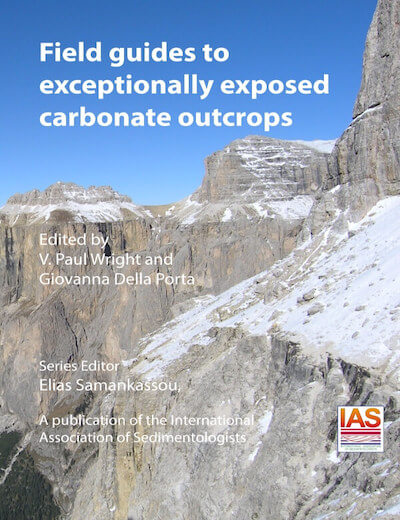
This exceptional volume presents fourteen detailed and richly illustrated examples of classic carbonate platform outcrops spanning an age range of Devonian to Miocene and locations including Europe, North America, Australia, Africa, China and the Middle East.
One of the key aspects that makes geology uniquely different as a science is the nature of field data collection. The ability to identify myriads of features at different scales, often in incompletely exposed outcrops, commonly in physically demanding, sometimes uncomfortable or even hazardous conditions, and to be able to relate those observations to temporal and structural contexts, is one of the most demanding activities in natural sciences. This volume is a celebration of the achievements of how rigorous field geology has elucidated the interaction of physical and biological processes over 400 million years (from Devonian) of Earth history, to produce often spectacular carbonate outcrops. In doing so, it illustrates what, for many of us, makes geology different and special. The guides in this volume are the culmination of many hundreds of person-years of painstaking fieldwork. The documentation and interpretation have been based on the ever-evolving understanding of how large-scale carbonate systems develop.
As sedimentary geology moves away from its early phase of outcrop data collection, improved descriptive techniques and comparative studies towards increased quantification and modelling, we become more and more aware of the secular differences in carbonate systems and that the present is not necessarily a key to the past for the geological record of carbonate successions and depositional systems. Demonstrating these secular differences using outcrops is the theme of this compilation. The field itineraries in this volume capture the diversity of carbonate platform types through time as the producers of carbonate sediments have changed as a result of biological evolution and global environmental, geodynamic and climatic changes.
You may also request the full resolution PDF version (4.2GB; print ready) or request an order form for a print copy at a Member discount price through the contact form.
Chapters
Chapter Name / Number
Page
Introduction to: Field Guides to Exceptionally Exposed Carbonate Outcrops (V. Paul Wright and Giovanna Della Porta). DOI: 10.54780/IASFG3/00
-
Devonian reefal carbonates of the Lennard Shelf, Canning Basin, Western Australia: Field guide for a classic carbonate outcrop of the world (Ted E. Playton, Charles Kerans, Roger M. Hocking, Peter W. Haines, Erwin W. Adams, Neil F. Hurley and Edmund L. Frost III). DOI: 10.54780/IASFG3/01
-
Pennsylvanian high-relief microbial boundstone-dominated carbonate platform margins (Sierra del Cuera, Asturias, Spain) (Giovanna Della Porta, Juan R. Bahamonde, Jeroen A.M. Kenter and Klaas Verwer). DOI: 10.54780/IASFG3/02
71
Natural laboratory for studying stratigraphic architecture, facies tract distribution and syndepositional deformation in carbonate ramps and steep-rimmed platforms: Guadalupe Mountains, West Texas and New Mexico (Charlie Kerans, Chris Zahm, Beatriz Garcia-Fresca and Paul (Mitch) Harris). DOI: 10.54780/IASFG3/03
128
Stratigraphic evolution of a latest Permian to Late Triassic isolated carbonate platform: The Great Bank of Guizhou, South China (Brian M. Kelley, Daniel J. Lehrmann, Meiyi Yu, Marcello Minzoni, Paul Enos, Xiaowei Li and Jonathan L. Payne). DOI: 10.54780/IASFG3/04
179
The depositional architecture of Latemar and Sella, isolated Triassic microbial platforms of the Dolomites, NE Italy (Nereo Preto, Piero Gianolla, Marco Franceschi, Giovanni Gattolin and Alberto Riva). DOI: 10.54780/IASFG3/05
209
Facies types and architecture of a Triassic high relief carbonate system terminated by subaerial exposure (Lombardy, Southern Alps, N Italy) (Fabrizio Berra and Flavio Jadoul). DOI: 10.54780/IASFG3/06
265
Lower and Middle Jurassic platforms and ramps from the High Atlas of Morocco (Óscar Merino-Tomé, Giovanna Della Porta, Aurelien Pierre, Jeroen A.M. Kenter, Christophe Durlet and Klaas Verwer). DOI: 10.54780/IASFG3/07
311
A journey along the Gargano promontory (Southern Italy): The Late Jurassic to Eocene Apulia Carbonate Platform evolution (Michele Morsilli, Alex Hairabian, Jean Borgomano, Sergio Nardon, Erwin Adams and Guido Bracco Gartner). DOI: 10.54780/IASFG3/08
395
Depositional geometries in Barremian platform carbonates from south-eastern France (Annie Arnaud-Vanneau, Hubert Arnaud, Thierry Adatte and Alexis Godet). DOI: 10.54780/IASFG3/09
481
The Mid-Cretaceous Natih Formation in northern Oman: a model for platform-intrashelf basin depositional systems and associated petroleum habitat (Philippe Razin, Carine Grélaud and Frans van Buchem, with contributions by Peter Homewood and Volker Vahrenkamp). DOI: 10.54780/IASFG3/10
515
Danian (Lower Paleocene) shallow carbonates from the Urbasa-Andia plateau (W Pyrenees): Contrasting models of facies architecture and early diagenesis across a greenhouse ramp to reef-rimmed shelf system (Juan Ignacio Baceta, V. Paul Wright and Ana Berreteaga). DOI: 10.54780/IASFG3/11
587
Mut Basin, Turkey: diverse carbonate depositional styles and mixed systems (Phil Bassant, Xavier Janson, Kemal Gurbuz, Kadir Eriş and Frans Van Buchem). DOI: 10.54780/IASFG3/12
645
The upper Miocene reef-rimmed platform of Mallorca (Spain): factory structure, growth dynamics and diagenesis (Luis Pomar L., Juan Ignacio Baceta and G. Mateu-Vicens). DOI: 10.54780/IASFG3/13
695
Depositional geometries in Barremian platform carbonates from south-eastern France [Supplementary Information]
-
Devonian reefal carbonates of the Lennard Shelf, Canning Basin, Western Australia: Field guide for a classic carbonate outcrop of the world [Supplementary Information]
-
The Mid-Cretaceous Natih Formation in northern Oman: a model for platform-intrashelf basin depositional systems and associated petroleum habitat [Supplementary Information]
-
Lower and Middle Jurassic platforms and ramps from the High Atlas of Morocco [Supplementary Information]
-
About this book
Year of publication
2021
Author/s
Giovanna Della Porta, V. Paul Wright
Description
This exceptional volume presents fourteen detailed and richly illustrated examples of classic carbonate platform outcrops spanning an age range of Devonian to Miocene and locations including Europe, North America, Australia, Africa, China and the Middle East.
One of the key aspects that makes geology uniquely different as a science is the nature of field data collection. The ability to identify myriads of features at different scales, often in incompletely exposed outcrops, commonly in physically demanding, sometimes uncomfortable or even hazardous conditions, and to be able to relate those observations to temporal and structural contexts, is one of the most demanding activities in natural sciences. This volume is a celebration of the achievements of how rigorous field geology has elucidated the interaction of physical and biological processes over 400 million years (from Devonian) of Earth history, to produce often spectacular carbonate outcrops. In doing so, it illustrates what, for many of us, makes geology different and special. The guides in this volume are the culmination of many hundreds of person-years of painstaking fieldwork. The documentation and interpretation have been based on the ever-evolving understanding of how large-scale carbonate systems develop.
As sedimentary geology moves away from its early phase of outcrop data collection, improved descriptive techniques and comparative studies towards increased quantification and modelling, we become more and more aware of the secular differences in carbonate systems and that the present is not necessarily a key to the past for the geological record of carbonate successions and depositional systems. Demonstrating these secular differences using outcrops is the theme of this compilation. The field itineraries in this volume capture the diversity of carbonate platform types through time as the producers of carbonate sediments have changed as a result of biological evolution and global environmental, geodynamic and climatic changes.
You may also request the full resolution PDF version (4.2GB; print ready) or request an order form for a print copy at a Member discount price through the contact form.
Series Editor
Elias Samankassou
Subject/s
-
Last updated
18 March 2026
Copyright status
© 2021 International Association of Sedimentologists. ISBN 978-1-7398845-0-5
How to access
Get access to publications, books, grants and more with your IAS membership